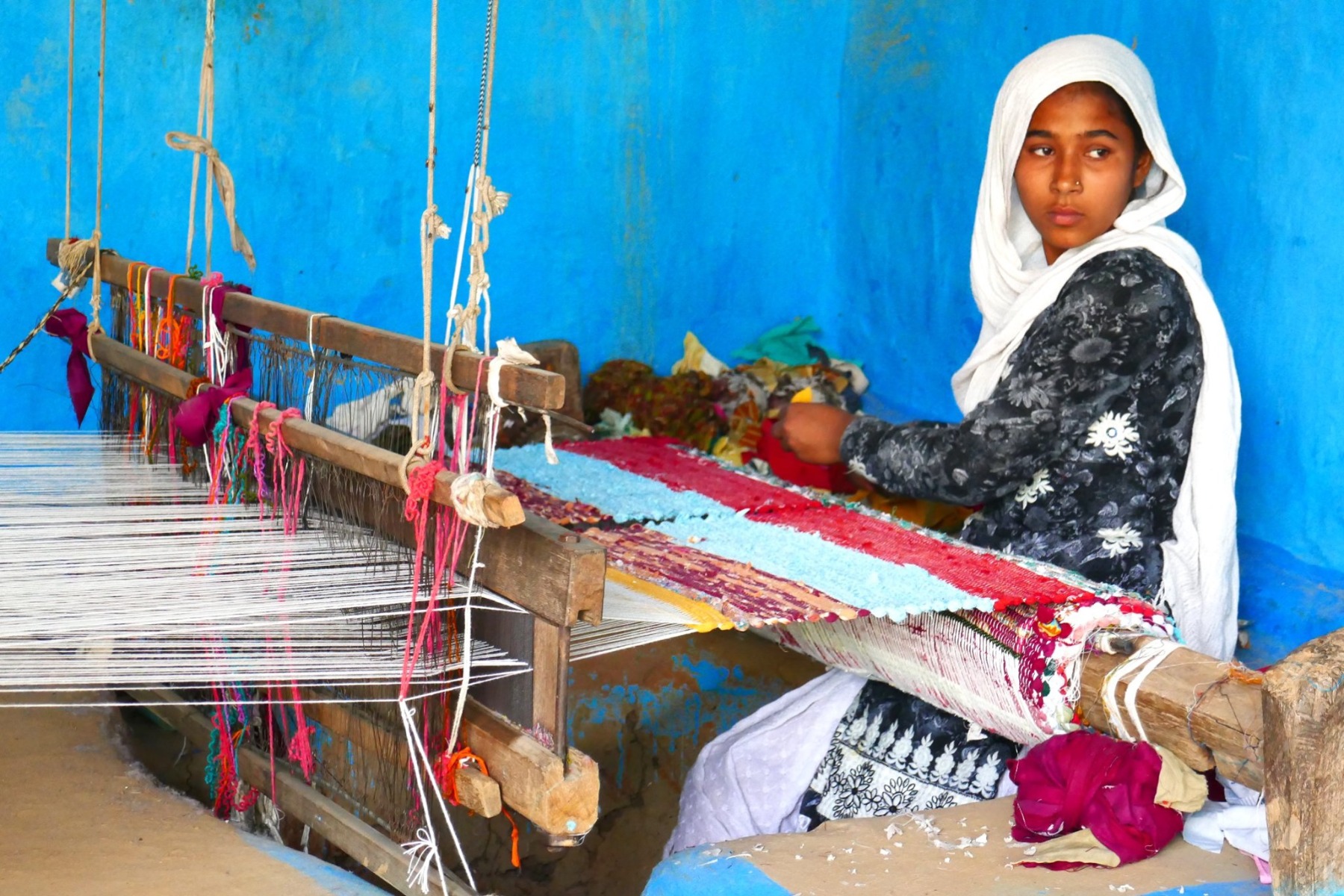
The Rag Rugs of Timli Village

The hilly terrain of Garhwal, Uttarakhand is rocky and the little farming that is done is rain-fed and labour intensive while the yield is low. As there are not many opportunities there to earn a living, the men migrate to cities looking for work, mostly manual labour, leaving behind the women and the old to fend for themselves.
 
The women of this region are very hard working and most young women work as seasonal labourers in the nearby fields. At other times, they weave rag rugs from waste for the local market, using strips of old clothing. There is a regular demand for floor mats, long runners and the larger rugs needed for the bitter cold winter months. Almost every household has a pit loom in a corner of their home. Whoever is free – mother, daughter, sister-in-law – would assist in cutting the old clothes into strips, which are used as the weft for the rag rugs they weave. They can make four or five rugs in a day, and for this they collectively earn Rs100 to 150.


Priyanka, one of the girls I met there, is studying to become a school teacher, but continues to weave in her free time. She saw the shocked expression on my face when I learnt how little they earn and explained, ‘In these hard times, this money is precious for us. It is regular work and also a good way to pass our time.’
They might earn more, around Rs.200 a day, working in the fields for daily wages, but the work is erratic as farming is dependent on the rains. Working in the fields would also take them away from their homes and not all women are able to get away for the whole day. Weaving at home has the advantage of flexible work hours and they can weave at their own convenience when they have free time. Life in these remote villages is tough but, by and large, the women seemed cheerful. They would much rather continue living in the village because of the support they receive from the community. They only hope to earn better wages for their work so that they can improve their financial condition.
 
At present, the feriya (local trader) collects these rugs and carts them around from village to village, exchanging the rugs for old clothes. People in this region are poor and cannot afford to pay a lot in cash for these floor rugs. He barters the rugs for old clothes equivalent to the weight of the rug and additional cash of Rs.100 or less, depending on the size.
 
This is a good example of sustainability where old clothes are recycled into sturdy, functional floor coverings that are used by the local communities. Some basic inputs, such as colour sorting the rags before weaving and over-dyeing the rugs, could help in making the product more attractive. With an appropriate narrative, these rugs could fetch a better price in urban markets.
view: 0 Categories: Uttarakhand By: Bandhejstore

About the Author

Archana Shah

Archana Shah

Archana Shah graduated from the National Institute of Design (NID) in 1980. Soon after graduating from NID, she travelled to remote corners of the country to study, understand and experience the vast variety of weaving, dyeing, printing, embroidery and ornamentation techniques practised by different communities.

This proved to be a very enriching journey, and the unique skills of the people of various regions, their distinctive colour palettes, and rich design vocabulary became the base for all her future work.

In 1985, Archana started a clothing company, BANDHEJ, a label influenced by the traditional textiles and craft skills, created for Indian women, with a very Indian sensibility. Today, Bandhej is a recognised brand, with a chain of stores in Ahmedabad, Mumbai, Bangalore, Delhi, Kolkata, Pune and Cochin.

Apart from this, she has designed costumes for a few feature films such as Bhavni Bhavai, Mirch Masala, Hun, Hunshi, Hunsilal and costumes for theatre. 1985 – 1997 she also worked on Festival of India inaugurations at Paris, Moscow, Leningrad and Tashkent to design architectural textile installations to create an Indian mood.

More recently she has published a book - SHIFTING SANDS, Kutch: A Land in Transition. The book is a personal journey of discovery and about her association of over 30 years with the land, people and their craft.

view: 0 Categories: Uttarakhand By: Bandhejstore

About the Author

Archana Shah

Archana Shah

Archana Shah graduated from the National Institute of Design (NID) in 1980. Soon after graduating from NID, she travelled to remote corners of the country to study, understand and experience the vast variety of weaving, dyeing, printing, embroidery and ornamentation techniques practised by different communities.

This proved to be a very enriching journey, and the unique skills of the people of various regions, their distinctive colour palettes, and rich design vocabulary became the base for all her future work.

In 1985, Archana started a clothing company, BANDHEJ, a label influenced by the traditional textiles and craft skills, created for Indian women, with a very Indian sensibility. Today, Bandhej is a recognised brand, with a chain of stores in Ahmedabad, Mumbai, Bangalore, Delhi, Kolkata, Pune and Cochin.

Apart from this, she has designed costumes for a few feature films such as Bhavni Bhavai, Mirch Masala, Hun, Hunshi, Hunsilal and costumes for theatre. 1985 – 1997 she also worked on Festival of India inaugurations at Paris, Moscow, Leningrad and Tashkent to design architectural textile installations to create an Indian mood.

More recently she has published a book - SHIFTING SANDS, Kutch: A Land in Transition. The book is a personal journey of discovery and about her association of over 30 years with the land, people and their craft.